…there is nothing more surreal, nothing more abstract than reality.
Giorgio Morandi
Plant Sale
Because I have no roots to speak of
I choose a bulbous specimen
George tells me is indestructible
and if I lived in Mexico would grow
the size of my kitchen table. I carry it
home in the car like an adopted child.
When its blanket of gravel spills
beneath the seat, I panic, swerve;
it stays steady, stoutly anchored.
I water it and slip its tan plastic
inside purple ceramic, happily
matching the base of its leaves, folded
into each other, like family, where one
and many gather. These leaves, searching,
thinning to nothingness, sprout
from the scaly caudex in a topknot
of bright ideas that might make a difference
to the air it lives in, which I swallow,
changed already for seeing it there,
taking up residence on my windowsill,
elephant’s foot going nowhere.
What’s writing really about?
It’s about trying to take fuller possession
of the reality of your life.
Ted Hughes
I spent most of this afternoon looking at a buttercup. An exercise in Goethe’s system of observation, I was testing my powers of perception and a wayward creeping buttercup (Ranunculus repens) on the edge of my lawn was a convenient subject. I liked the idea of giving such an easily overlooked flower so much attention. Although I did have a rival – an elegant bronze fly feeding on its pollen. The process is that you look closely, paying attention to every single detail of the plant’s structure, its colour, habit and ‘feel’ – much in the way that a botanical illustrator might in order to be able to make an accurate representation.
As if part of me knew that it wasn’t a plant to touch or taste, I discovered when I looked it up later that the highly acrid buttercup is poisonous to cattle and can cause blisters in humans. Beggars used to rub them on their skin to induce sores and elicit sympathy. An old cure for lunacy was to hang buttercups in a bag round someone’s neck (probably a poet’s). Its original name was butterflower or crowfoot. You can see from the photo that some creature wasn’t put off by the flavour…
Observing the buttercup so closely, in sunshine and under cloud, I hope I was able to enter into an intimate understanding with it and come to know what Goethe called its ‘archetype’ – a process not unlike the way I tend to approach writing a poem about a flower. Unsurprisingly, what was suggested was a child-like quality, playful, radiant and very strong. We used to hold a buttercup under each other’s chins to see if we liked butter. I’m not sure children still do that, which seems a terrible pity.
The glass-blue days are those
When every colour glows,
Each shape and shadow shows.
Blue be it: this blue heaven
The seven or seven times seven
Hued sunbeam will transmit
Perfect, not alter it.
Gerard Manley Hopkins
The Blessed Virgin compared to the Air we breathe
Today gathering kindling in the woods behind my house it was lovely to see the drifts of wood sorrel bathed in sunlight. Now the season’s a little more sure of itself, I’m starting to enjoy exploring the contrasts between Home and Away, North and South and City and Country – a strong impulse for my writing.
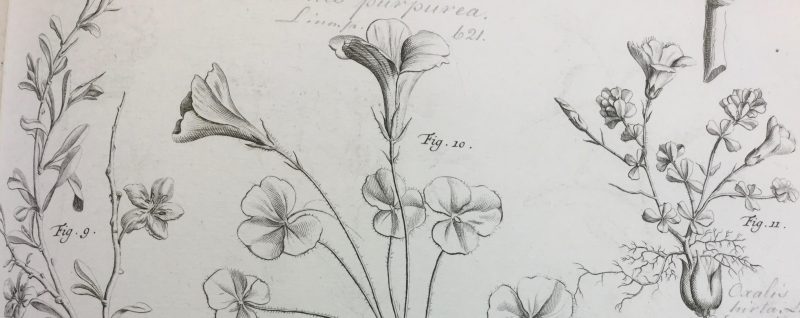
Oxalis acetosella (wood sorrel or common wood sorrel) is also known as Alleluia, as it generally flowers between Easter and Pentecost. Like everything else, it’s late this year but the coolness will also keep it in bloom for longer than usual. The acetosella part of its name refers to the tart citrusy flavour of the leaves; heart-shaped and folded, they are a particularly vivid green. The white flowers have fine mauve lines pencilled inside each petal.
Tonight it’s Vesakha Puja – the full moon of May being the traditional time to celebrate the Buddha’s birthday. Blessings on all beings this holiday weekend!
The most interesting things in life often happen by accident.
The opening sentence of The Tulip by Anna Pavord (Bloomsbury, 1999)
Perhaps it’s because I’m on the brink of a birthday but recently I’ve been thinking about how memory works and noticing my changing relationship with it. I used to think that memory and imagination occupied different compartments of my brain – particularly in relation to the making of a poem. Lately I’m more inclined to think they’re aspects of the same impulse – our need for assimilation and understanding. Memories aren’t fixed – they evolve over time and there’s always more to uncover than you think there is.
Since I became more thoroughly aware of that, I’m less interested in writing about ‘the past’, which feels like a slightly skewed concept – much more intricately stitched into our present experience than is always comfortable. If it’s true that we are the sum of our thoughts, words and actions, the past, present and future can be seen to work in parallel –all with the potential to be changed by our making different choices. I’ve often thought of this as manifest in the process of choosing the next word (and the next and the next etc) when writing a line of poetry. None of it is inevitable, although we might persuade ourselves it is so.
Today I have been looking at a friend’s gift of tulips (a gorgeous variety called Angélique). They’re just getting blousy – that knack tulips have of dying so very beautifully. Over sixteen years ago I must have looked at another gift of tulips and wrote Still Life (from Storyville, Bloodaxe 1997). Re-reading it is like looking at an old photograph of myself, a historical translation. A great deal of my experience and how I would choose to express myself has changed but I recognize the almost physical impact of the flowers’ beauty, the pleasure that goes in through the eyes and touches something in the belly.
Isn’t this how memory and imagination works? Not in the brain at all but somewhere in the gut, all those nerve endings stimulated into communicating a sense of perception, of relationship and intimacy. How we choose to respond to that moment of recognition and connection affects what the future looks like. And today, how my new tulip poem might unfold and what the coming year may bring…
We abuse the land because we regard it as a commodity belonging to us. When we see land as a community to which we belong, we may begin to use it with love and respect.
Aldo Leopold
The latest update from Moorbank popped in my inbox this morning. I wanted to share it here, hoping that you might help spread the word. This is more than a good cause – saving Moorbank is an important way to help keep Newcastle green. It’s such an valuable resource for us all, whether we live in the city or not. Please give what you can – money, skills, energy, ideas, contacts etc.
Dear All,
Thank you for your continuing support of Moorbank. Since our last update, we have presented our feasibility study and project proposals to the Freemen of the City. Feedback has suggested that the site has a significant level of dilapidation, and as a result of this we are looking to raise capital to correct any issues. We have decided to carry out an independent survey of the buildings and glasshouses, and are in need of a surveyor who would be willing to carry this work out in the near future. Does anyone have any experience in this area, or perhaps knows a surveyor who could help with this? Please get in touch with us if you can help with this aspect by Thursday 23rd May as there is some urgency for this work to be carried out.
In addition, we are currently in partnership negotiations with a local College, and we are optimistic of the result. Unfortunately neither the college or the Friends have capital to spend on the upgrade of the site, so we intend to launch a campaign to raise funds to enable the ‘dilapidation of the site’ to be addressed. We have already approached some local Businessmen to ask for support, which has been favourably received, although as yet we do not know the level of investment that will be made. We will also be seeking funding from a range of trusts who offer funding to restore buildings. We are also hoping members of the public and Moorbank supporters might be willing to offer donations, and if you can help, we will have a donations box available on our forthcoming open days; as part of The Late Shows on Saturday 18th May (7pm-11pm) and as part of the National Gardens Scheme on Wednesday 22nd May (4pm to 8pm). If you are not able to make it to our Open Days, please send cheques payable to the ‘Friends of Moorbank’ to: Moorbank Botanic Garden, Claremont Road, Newcastle, NE2 4NL.
The Friends are in the process of setting up the Moorbank Botanic Garden as a limited company and we are hoping to involve a professional fundraiser to assist us in our cause. We will also be registering as a charity in the next few weeks which will allow us to claim tax back, and we will be eligible for a wider range of funds.
Finally, we are in the process of constructing a website and are interested in hearing from people who might be interested in helping provide content for this, along with content for our social media pages on Facebook and Twitter and our quarterly newsletter. If you are willing to carry out some writing and/or take photos about updates in the garden, horticultural news and other things linked to Moorbank, please get in touch.
Once again, thank you for your continued support of Moorbank in this difficult time. We hope to see some of you at our two Open Days over the next week and to hear from you if you can help with the above queries.
Kind regards,
Moorbank Botanic Garden Executive Committee
*
Please see our Facebook page for up to date news: www.facebook.com/moorbank
and our Twitter feed: www.twitter.com/growingmoorbank
I look forward to seeing as many of you who can make at the Open Day on Wednesday 22nd May.
Look deep into nature, and then you will understand everything better.
Albert Einstein
Just to let you know I’m doing a reading at the lovely Lit & Phil on Wednesday night (15th May) at 7pm.
I’ll be reading from Border Song, my collaboration with Kim Lewis.
And from new work that’s emerged from my recent botanical travels.
Do come along if you can, and let folk know who may not follow my posts here. I look forward to seeing you.
This week I’ve been re-visiting Singapore via my notes, photos and audio recordings. I was unsure how I’d manage the leap in my imagination, skipping back past the intensity of both Australia and Tokyo. Hearing the sounds again (birds, insects, cascading water plus my own commentary) was a revelation, whisking me right back to the sticky heat and lush exotic plants in the Botanic Gardens – which I was pleased to be reminded I was sorry to leave.
While I was there, I was reminded of the Malaysian poetic form, the pantoum, and I knew I wanted to experiment with that as a vessel for my impressions of the place. I’d never written one before and found its repetitions strained and awkward at first but once I got the hang of it, I’ve rather liked its strange braiding. Something about its haunted hesitations seems fitting for my disorientation when I landed in tropical, inexplicable Singapore from a very snowy UK.
In The Making of a Poem (Norton, 2000), Mark Strand and Eavan Boland write:
Of all verse forms the pantoum is the slowest: The reader takes four steps forward, then two back. It is the perfect form for the evocation of a past time….Since the pantoum easily enchants, the close repetition of lines sets up a tight, mesmerising chain of echoes. It is also a form that allows its listener to relax since all of the lines make a second appearance – what was missed the first time can be picked up on the second…And yet the form is certainly demanding for both reader and poet, with its strange twists of antinarrative time and its unexpectedly hypnotic repetitions.